
Klipsch OJAS kO-R2
$11,995
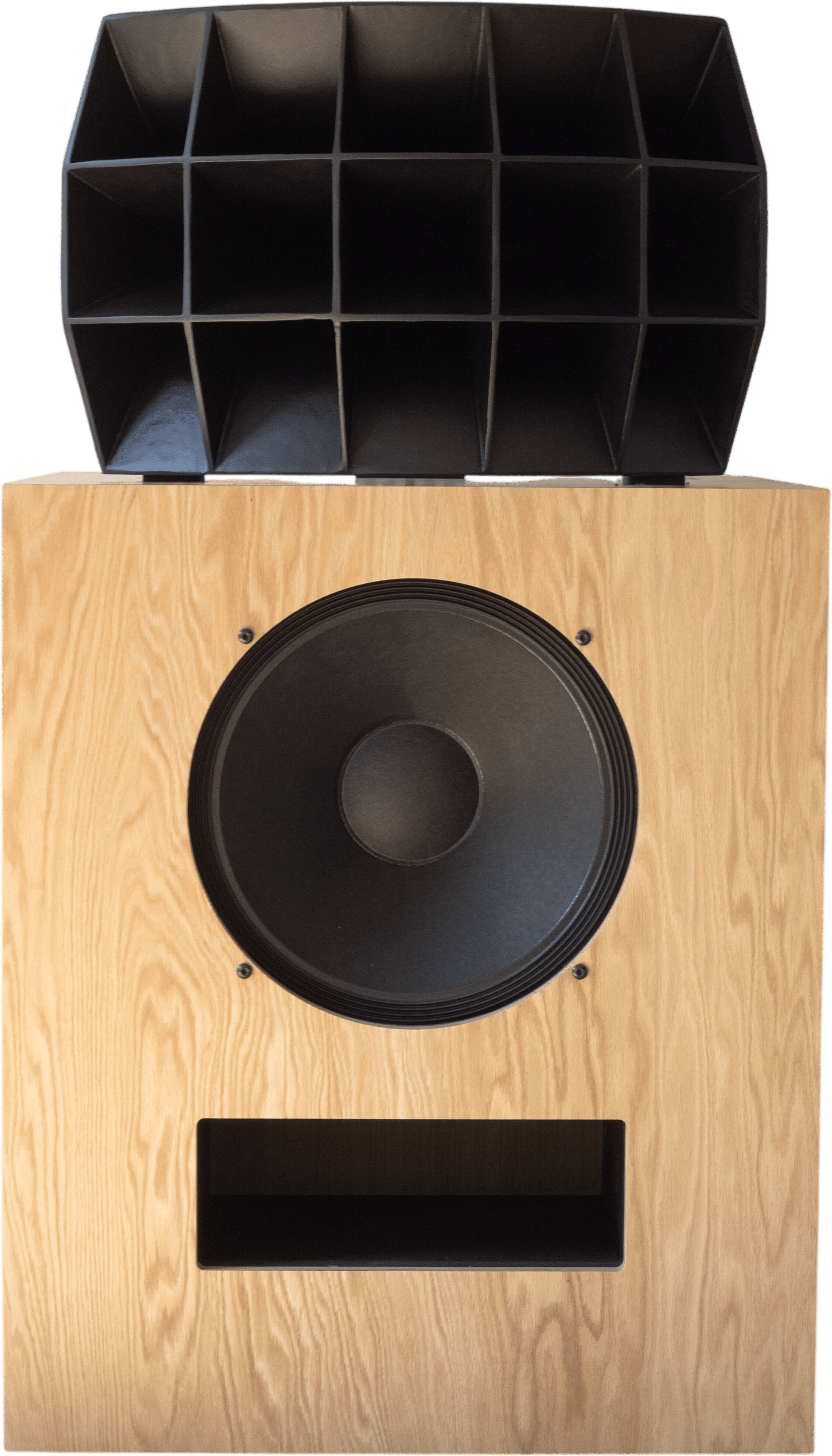
Devon Turnbill aka OJAS is somewhat of a hero of mine. First beginning his career in fashion, OJAS has an eye for visual design evidenced by his invitation to create several exhibits for design museums like Lisson and Cooper-Hewitt. His audio products aren’t just easy on the eyes; they take a completely different approach to most loudspeakers. Instead of focusing on utilizing complex, modern components to adhere to a specific frequency curve, OJAS’ speakers look backwards and endeavor to perfect the oldest and simplest designs from early 20th century American audio. The calling card for these speakers are their “horns” which leverage physics to naturally amplify sound waves rather than by raw power. This increases a speaker’s sensitivity or level of volume produced by a certain amount of power or current, which was required when amplifiers employed vacuum tubes that use a heating element to amplify a signal.
Back then, amplifiers could produce only a handful of watts, so speakers needed to be as sensitive as possible so their tube amps could produce sound at a listenable level. The speaker world got away from this design philosophy after the advent of transistors, which meant amplifiers could produce more power and by extension allowed speaker designers to utilize more complicated electronic components that made tweaking the sound easier but consequentially sucked up far more power. What was gained in convenience was lost in sound quality. Speakers began to sound more “veiled” or incoherent. That largely has been overcome in the past several decades, but normal box speakers will never be able to produce the inherently transparent sound that a horn-loaded speaker can.
OJAS spent a few years in Japan as a young audio engineer and became infatuated with old American audio and its horn-loaded speakers, which Japanese jazz bars or kissas use almost exclusively. The formula was simple—remove as many components as possible from the audio chain to try and get you as close to the music as possible. I’ve owned several nice speakers, and they all have their merits, but I keep coming back to OJAS because I forget I’m listening to speakers and just hear the source.
The ko-R2 is the second collaboration between longtime audio company and horn speaker stalwart Klipsch whose artisans produce their heritage speakers by hand in Hope, Arkansas. OJAS took their Heresy speaker components and rearranged them in his image with birch plywood or his signature grey hammer tone enclosures and his own horn design manufactured with old-world sandblasting techniques to create the ko-r1, which was limited to 50 pairs. The ko-R2 utilizes Klipsch’s Forte speaker components in an even larger design. I own the ko-r2s and have listened to all other OJAS speakers. I can say with a great deal of certainty that these will be ones to cherish for a lifetime.
23 days ago
Comments

Follow Thomas
By submitting, you agree to our Terms and Privacy Policy